

Is parchment paper or a silicone mat better for macarons? I tested the same French-meringue macaron batter on parchment, a silicone baking mat and a grooved macaron mat. All three made attractive shells - but underneath they told a different story. For me, parchment still gave me the best feet, flattest bases and most reliable bake.
I'm Jill Colonna, author of Mad About Macarons (2010), and I've been making macarons since 2006. This is simply what works best in my kitchen - if silicone mats work beautifully for you, keep using them.
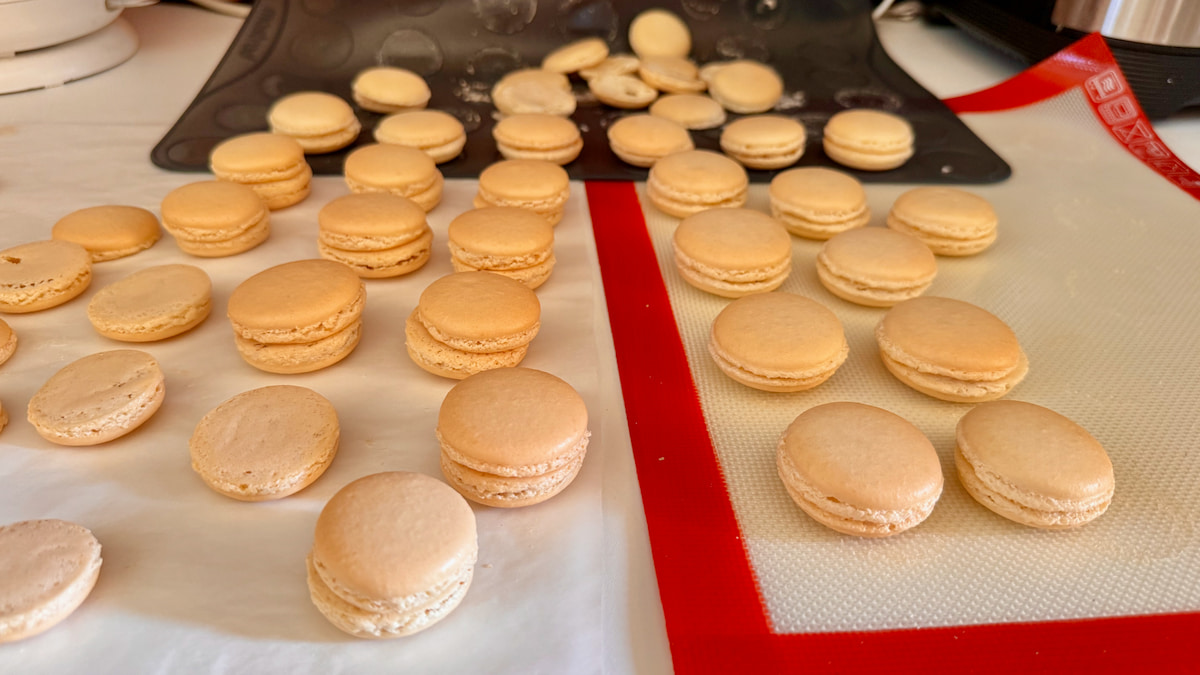
Table of Contents
- How I Tested Macaron Mats vs Parchment
- The Results
- Why Do Silicone Mats Give Smaller Feet?
- Do You Need a Silicone Mat for Macarons?
- Flat Silicone Mats vs Grooved Macaron Mats
- Mat Size and Baking Tray
- Why Are My Macarons Sticking?
- How to Use and Clean a Silicone Macaron Mat
- My Favourite Use for a Grooved Macaron Mat
- My Verdict: Parchment Paper Wins
How I Tested Macaron Mats vs Parchment
To make the test fair, everything was identical except the surface underneath:
- same batch of French-meringue batter, divided between trays
- same piping size (2.5 cm / 1-inch) and the same resting time
- same oven, temperature and shelf, one tray at a time
- same flat baking trays
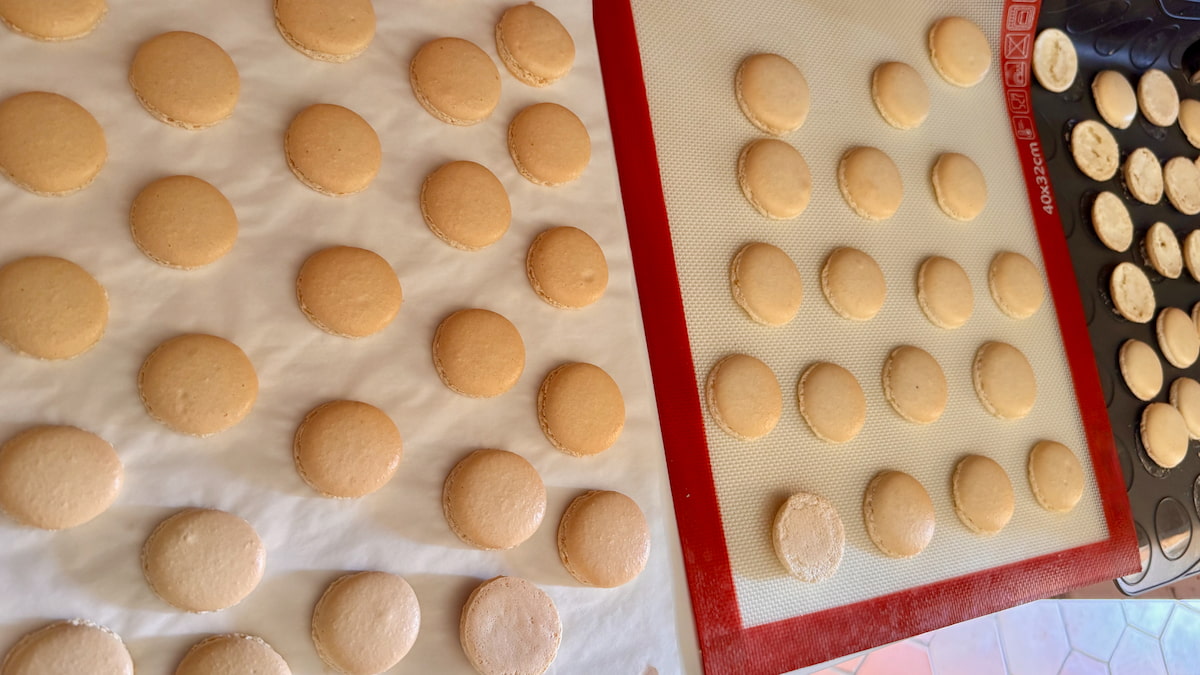
The three surfaces were good-quality baking parchment, a flat silicone baking mat and a grooved silicone macaron mat with raised circles.
The Results
For me, good-quality baking parchment wins.
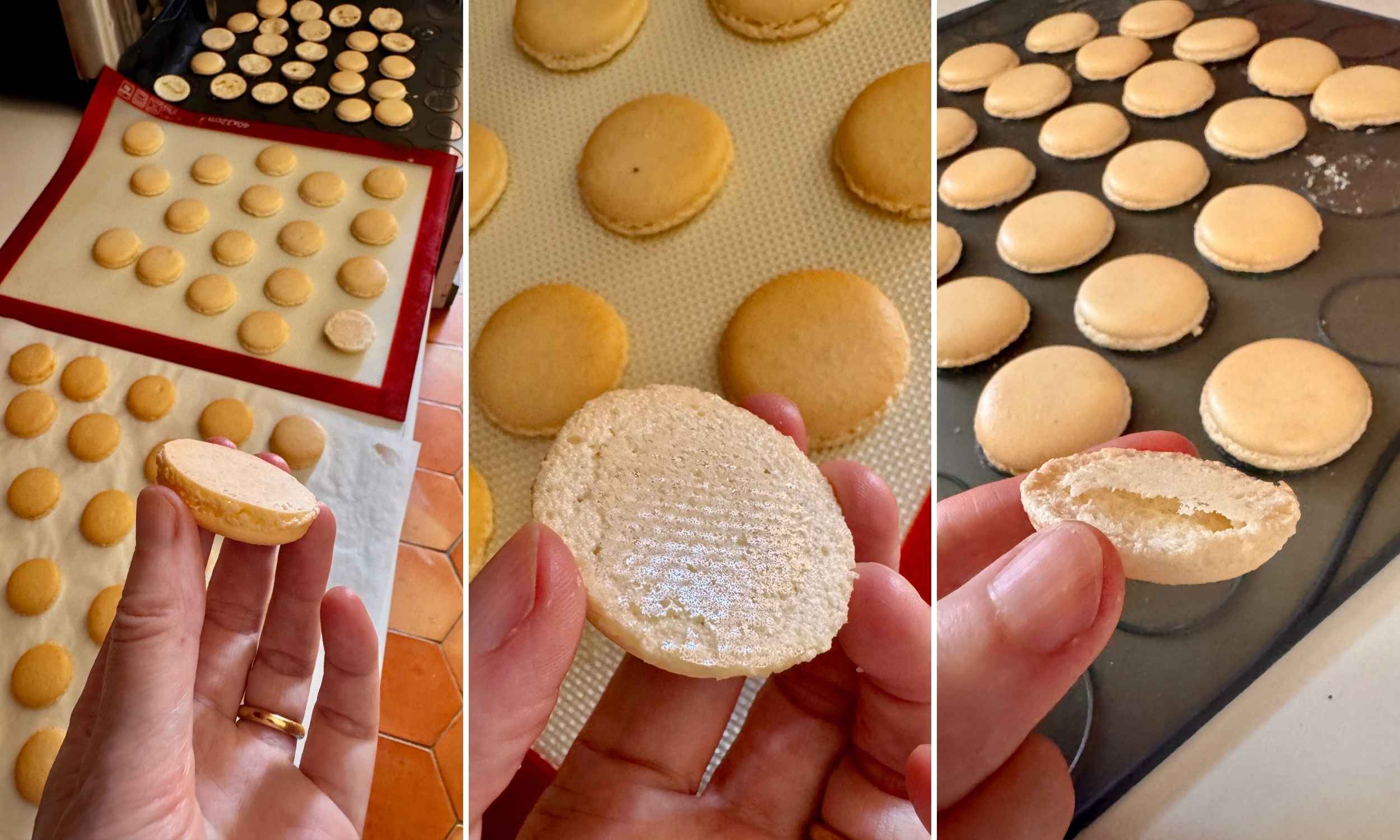
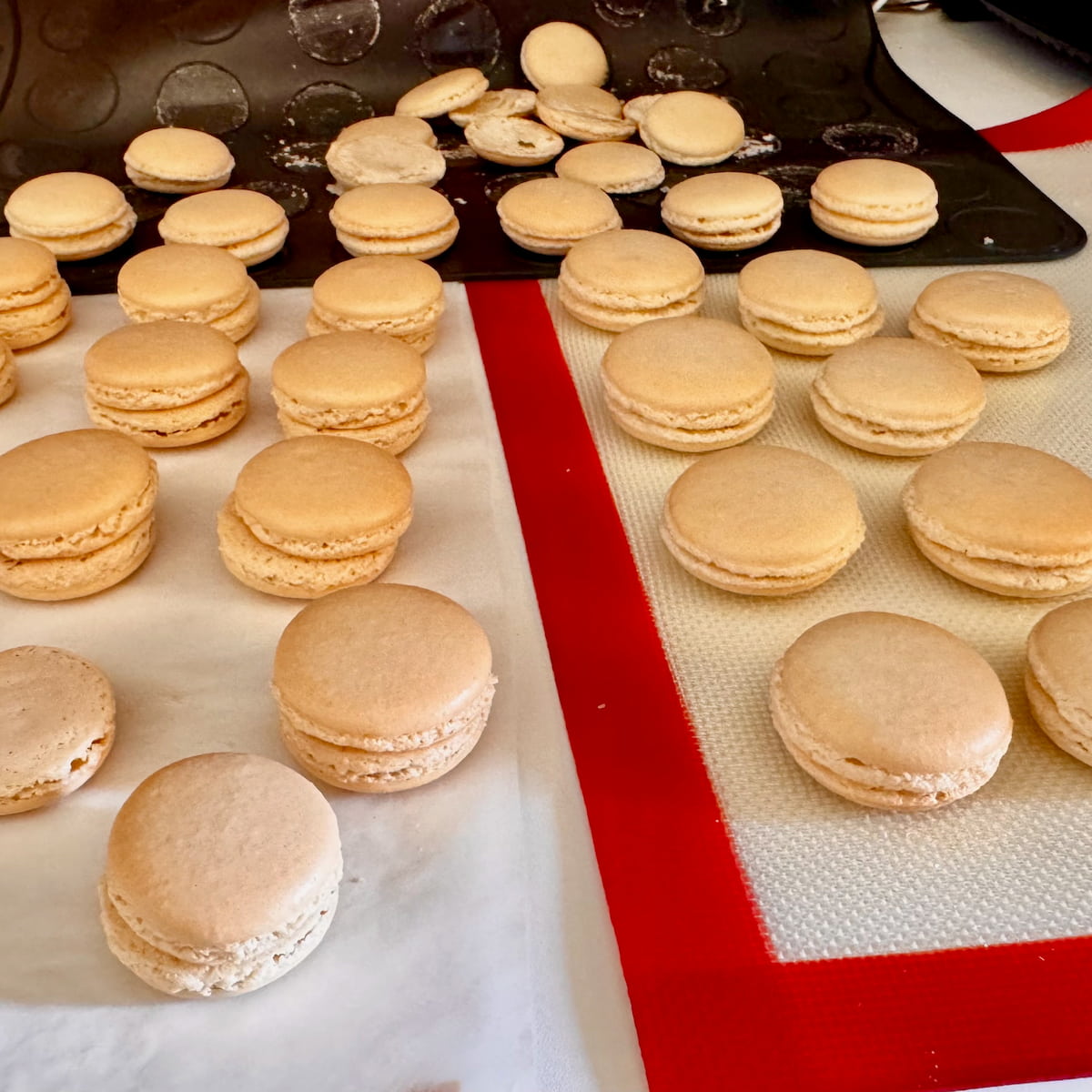
The parchment macarons had taller, more even feet, nicely domed shells and flat, matt bases. Both silicone mats gave smaller feet, flatter shells and shinier, slightly concave bases - and they needed slightly longer in the oven. At times with the mat, I even had no feet. Here's the comparison at a glance:
| Parchment paper | Flat silicone mat | Grooved macaron mat | |
| Feet | Tallest and most even | Smaller | Smallest |
| Shape | Nicely domed | Flatter | Flatter |
| Bases | Flat, matt and dry | Shiny, slightly concave | Shiny and more concave |
| Baking time | My usual time | Needed longer | Needed longer |
| Release | Peeled away cleanly once cool | Can stick if underbaked | Can stick if underbaked |
| My verdict | ? Winner | Workable | Not for me |
The biggest surprise was the grooved macaron mat. It does help you pipe evenly sized rounds, but the raised edges left the undersides shiny and hollowed, rather than flat.
Why Do Silicone Mats Give Smaller Feet?
This is the clearest differences in my tests each time. Parchment gives me higher, more pronounced feet. Both silicone mats produce flatter ones, with the grooved mat giving the smallest.
Silicone is an insulator, so heat reaches the base of the shell more slowly than through thin parchment on a metal tray. That seems to mean the feet don't rise as strongly, and the bases need longer to set.
That's also why mats can be confusing. If you bake for the same time as on parchment, the shells look done but are underbaked underneath. That's when you get sticky, concave bases, and more hollow shells.
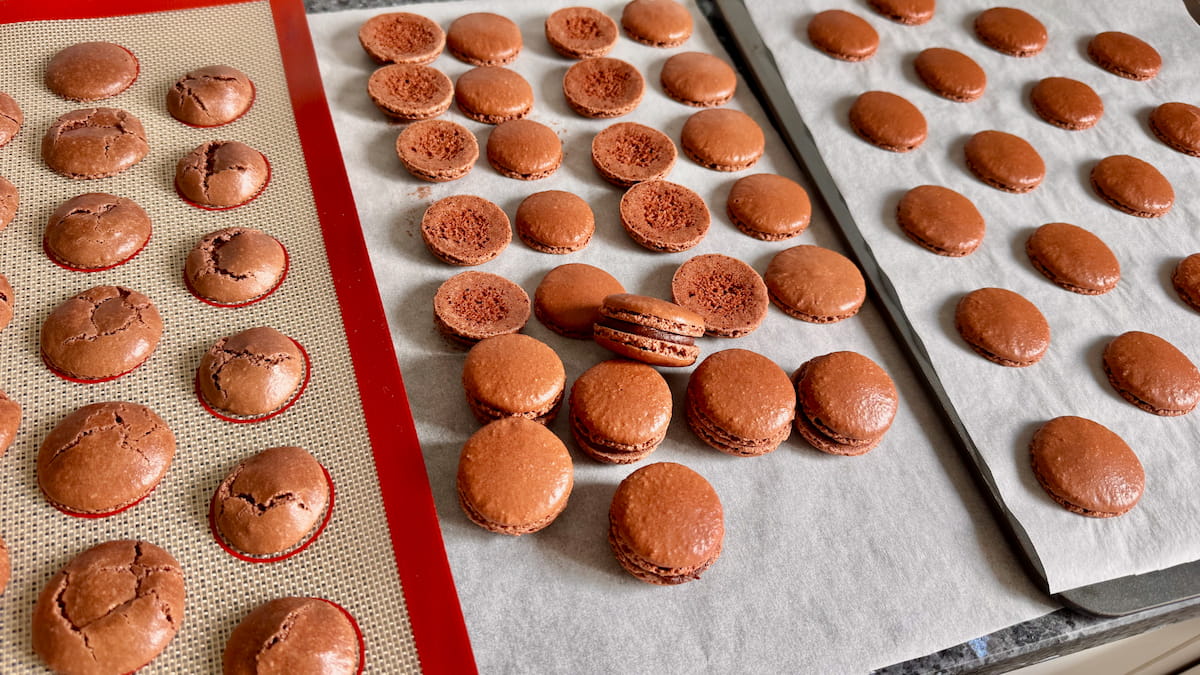
Mats also hold on to a thin film of grease over time, even when they look clean - and grease is never good news for macarons. That leads to no feet and cracks - just check out these chocolate macarons from the same batch with some grease on the mat.
Do You Need a Silicone Mat for Macarons?
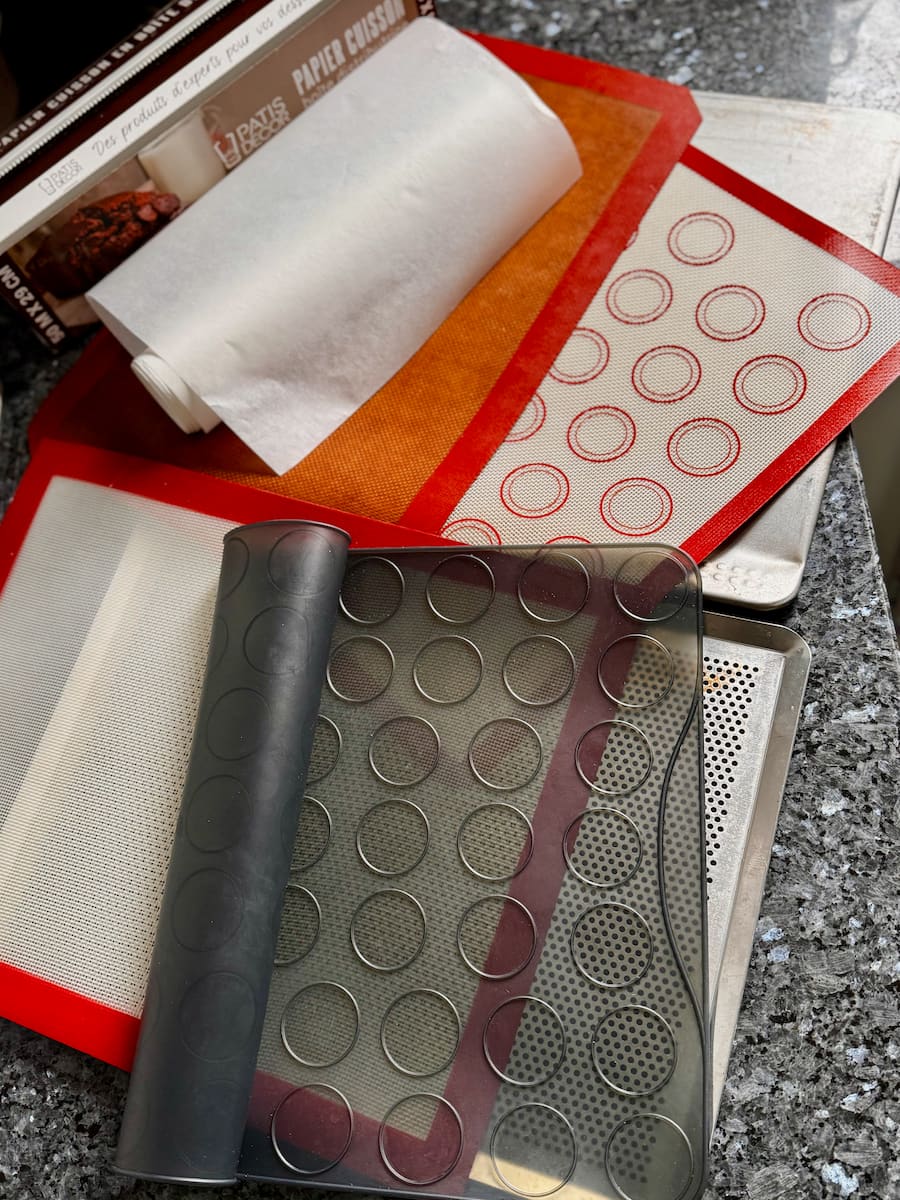
No. A silicone mat isn't essential, and I don't normally use one. Good baking parchment on a flat, heavy baking tray is all you need. It's inexpensive, easy to find, and in my tests it gives better feet and flatter bases.
Can You Make Macarons Without a Silicone Mat?
Absolutely - and I usually do. Use good-quality baking parchment, not wax paper, and hold the corners down with tiny dots of macaron batter if you have a stronger fan oven that lifts it.
For even sizing, slide a printable macaron template under the parchment while piping, then remove it before baking.
A flat baking tray matters too. A warped tray can give you lopsided shells whichever surface you use. If I use silicone, I also like placing it on a perforated metal baking tray.
Flat Silicone Mats vs Grooved Macaron Mats
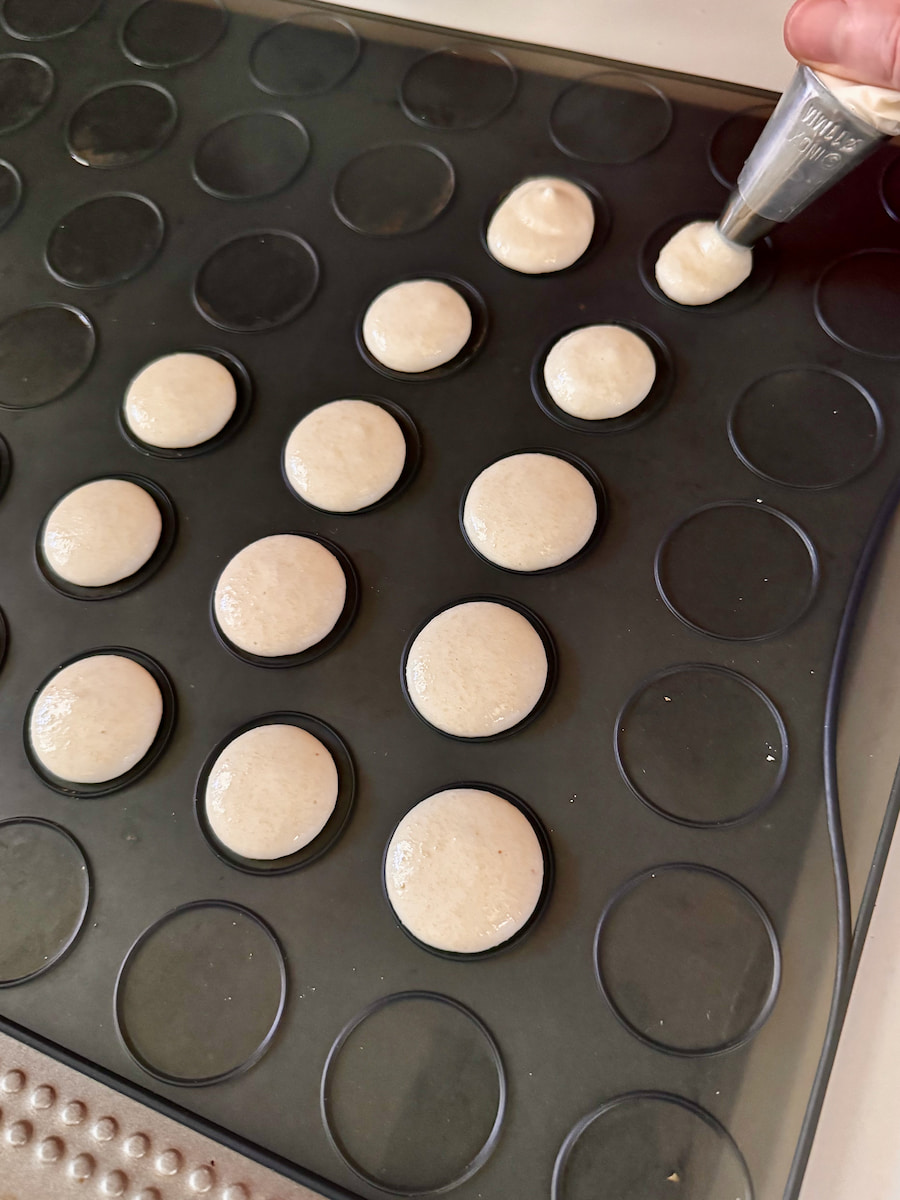
A flat silicone mat, including one with printed circles, simply gives you a visual piping guide. The raised circles sound helpful, but I find them more awkward than parchment.
You need to pipe neatly into the centre and leave enough room for the batter to spread. Pipe slightly off-centre and the shell can turn oval or reach the raised groove.
Rather paradoxically, you need fairly accurate piping to make the guide work well.
What About Double-Circle Macaron Mats?
You'll also see macaron mats with two circles rather than one. In my experience, they don't change very much. The extra circle gives another size guide, but you still need to pipe centrally and allow the batter room to spread.
If the circles are simply printed on a flat silicone mat, fine. If they're raised grooves, I still find parchment easier.
Mat Size and Baking Tray
it's worth checking the size of your mat and baking trays before buying one.
My grooved mat was slightly too large for one of my favourite trays, which meant it wasn't fully supported so some shells spread unevenly. Make sure:
- the entire mat lies flat on the tray.
- the tray fits comfortably in your oven.
- you use a strong, flat tray underneath.
For silicone, I now particularly like a perforated metal baking tray underneath.
Why Are My Macarons Sticking?
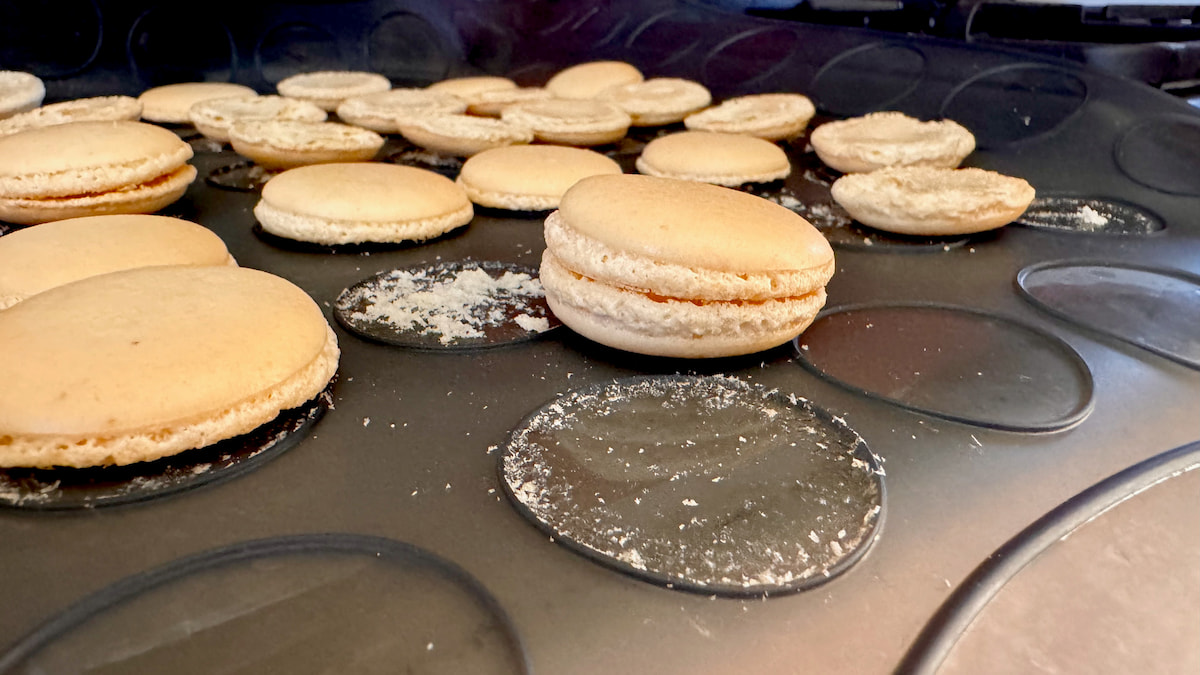
Sticking to paper or to silicone usually means:
- They're underbaked. This is the most common reason, especially on mats. Bake a couple of minutes longer.
- They haven't cooled. Leave them to cool completely before lifting.
- The mat isn't completely clean. Grease residue makes the bases stick.
How to remove macarons cleanly: let them cool completely, then peel the paper away from the shells, rather than pulling the shells off the paper. If they still cling, they need more baking - pop the next tray in for a minute or two longer.
How to Use and Clean a Silicone Macaron Mat
If you prefer silicone mats, a few tips will help:
- Keep one mat just for macarons, never for roasting or greasy baking.
- Wash it in hot soapy water and rinse well. To remove a greasy film, scrub gently with a paste of bicarbonate of soda and water, then rinse.
- Dishwasher? Many mats are dishwasher safe - check your manufacturer's instructions.
- Never oil it and replace it if it looks stained or smells. Older mats rarely give good macarons.
- Bake a little longer than on parchment - test one shell before taking the tray out.

My Favourite Use for a Grooved Macaron Mat
I no longer use my grooved mat for macarons but I definitely haven't thrown it away. Those circles are perfect for making this French Chocolate Mendiants recipe.
Spoon the melted chocolate into the grooves, decorate with dried fruit and nuts, leave to set, then peel the silicone away. You get beautifully round chocolate discs with almost no effort.
No wastage - and very French.

My Verdict: Parchment Paper Wins
For me, parchment paper wins every time: better feet, flatter bases and reliable timing. Silicone mats can work if you bake longer and keep them spotless, but I wouldn't buy a grooved macaron mat for beginners. A free printable template under parchment does the same job, without the concave bases.
That's my opinion after many batches in my own kitchen. If mats give you better results, go ahead! Macarons are all about finding what works in your own oven.
Recommended: baking parchment; sturdy flat baking tray.
Originally published 31 August 2012. Completely retested and updated.
Want More Macaron Help?
For my beginner recipe, troubleshooting fixes, fillings, tips and Paris favourites, see my complete French Macaron Guide


Terry
I just finished a 3 hour Macaron class. I'm so glad that I did it. I made some amazing cookies and amazing fillings. I feel very comfortable and confident that I can make amazing homemade Macarons. We made Hazelnut with Dark Chocolate Ganache, Pumpkin with Salted Caramel Buttercream and Spiced with Apple Cider Buttercream.
Deborah
Thanks for the information about the mats. I've been using a Silpat since I started making macarons and I wondered why it was taking them longer to cook than the recipe calls for. When I was in France earlier this week I noticed in a store a macaron mat that had little round "pockets" for macarons and I wondered how it worked. I'd actually come online today to see if I could buy one in the US, and having read your blog I've decided to try parchment paper instead. Thanks for the helpful tips!
Jill
So glad you saw this before buying, Deborah. Only too pleased to help.
Mia D
I have the Silicone Macaron macaroon Baking Sheet. Use them couple times fine. Today all of them were sticky (Why?). The same time i did with the baking parchment. The ones baked in the silicone were much nicer looking color from the same batch. Next time i will try one silicone with oil, one with water to see if is any difference.I was told that if you run little water on the silicone and drain, it may work....
Jill
Interesting experiment, Mia. As I say in the post, out of all my trials with the mat compared with good quality (that's important) baking parchment, the parchment came up with the best all-around performance - especially with better feet than the mat. I mention to use an oil to help on the mat - I went no further so if you want to experiment with the water, please do let us all know here! Have fun!
Judi
Thanks for all the info - tried making macaroons only once so far and not very successfully. We used an insulated baking sheet under a silicone mat and under parchment paper. Is it better to use an regular non-insulated cookie sheet.
Jill
Hi Judy,
As I say here, I don't recommend using a silicone mat to make macarons. I just used a regular baking tray/cookie sheet with a good quality baking/parchment paper. Don't worry about it - it's only your first time. Try again, keep it simple and just stick to what I say in the book and you'll have fun!
Judi
Thanks for the reply - it was a metal insulated cookie sheet not a silicone mat. There is a layer of air between two metal sheets - they are called AirBake. We use them for cookies so they don't burn on the bottom but I wondered if it was not suitable for macarons. We'll try using a regular cookie sheet next time. We still ate them and they tasted good just didn't look like they should.
Jill
Sounds a super duper cookie sheet, Judi. No, don't know of it, just use regular sheets and it works great. Enjoy making the next batch - taste was good for the first? That's what it's all about, isn't it?
Kevin
I have made macarons with parchment paper a few times and they came out good. Used sillpad under same condition and the shell burst on top.no feet Can you tell me why? Thanks
Jill
Kevin, I think this scenario just adds to what I'm saying here. Let's stick to baking/parchment paper and keep life easy! Thanks for your feedback.
Kevin
Ok thank you for your response.
Evelyn
Hi, what should I use to oil the macaron silicon mold mat?
Jill
Hi Evelyn, suggest a light oil such as grape seed oil, but very little of it.
jeanell
You are gonns think Im crazy but used a small round cookie cutter as a mold for awhile til I perfected the round one. Once you tapped the trays to released air bubbles you would never tell.
Jules
Hi Jill,
Do you have any techniques for hand piping very round macarons? I'm considering a mat because the ones I pipe aren't very round. Is there maybe some other tool that can be used? It sounds like the silicone mat makes the feet smaller which is less desirable.
Thanks!
Jules
Oh and to be clear, I'm using a round template, but it's my technique that makes them not perfectly round, and that bugs me 🙂
Jill
Hi Jules, I honestly don't think a mat is really beneficial to round macarons and, as I've said here, you not only get smaller macaron feet but it's almost as tricky piping onto the exact mat's circles than piping free hand! I'd suggest you follow all of my tips and recommendations thoroughly in the book. It sounds like your batter is perhaps a bit runny and so more difficult to control. Once you have a batter that's manageable, then it will be easy to pipe out using a plain tip right onto the baking paper.
Aleli (lily)
Hello! I wonder what parchment paper brand would be good to use? And how do you make your macaron rounds even and with almost no batter tips?
Jill
Hi Lily, Depends where you live but as I live in France I can only suggest Monoprix own brand which I particularly prefer. I've just asked my readers on the FB page. In the meantime, the answer is far too long to your 2nd question. It's all in the book!
Tammy
I recently made some macarons and i even when out and bought some fairly good parchment paper, but of course they still stuck so i went to my last resort and used some that i got from Costco (I am from the US) and they worked AMAZINGLY for some reason the parchment paper from Costco is price very good and works even better!
Jill
Thanks for this, Tammy - it's very useful for our USA friends. I noticed a few people mentioning this on our FB page. OK, so let's stick to Costco parchment paper for macarons! Merci beaucoup.
Paul
I have two mats and get about 25% of the shells peeling off well. The others come off with a butter knife and a slow hand and a repair job. I love the idea of the mats and will try some oil spray next time. I accidentally left the last batch in 10 minutes longer than usual and they turned out better than other times. I'll give baking parchment a go and see what happens. If only I could make them last a little longer.