

Is parchment paper or a silicone mat better for macarons? I tested the same French-meringue macaron batter on parchment, a silicone baking mat and a grooved macaron mat. All three made attractive shells - but underneath they told a different story. For me, parchment still gave me the best feet, flattest bases and most reliable bake.
I'm Jill Colonna, author of Mad About Macarons (2010), and I've been making macarons since 2006. This is simply what works best in my kitchen - if silicone mats work beautifully for you, keep using them.
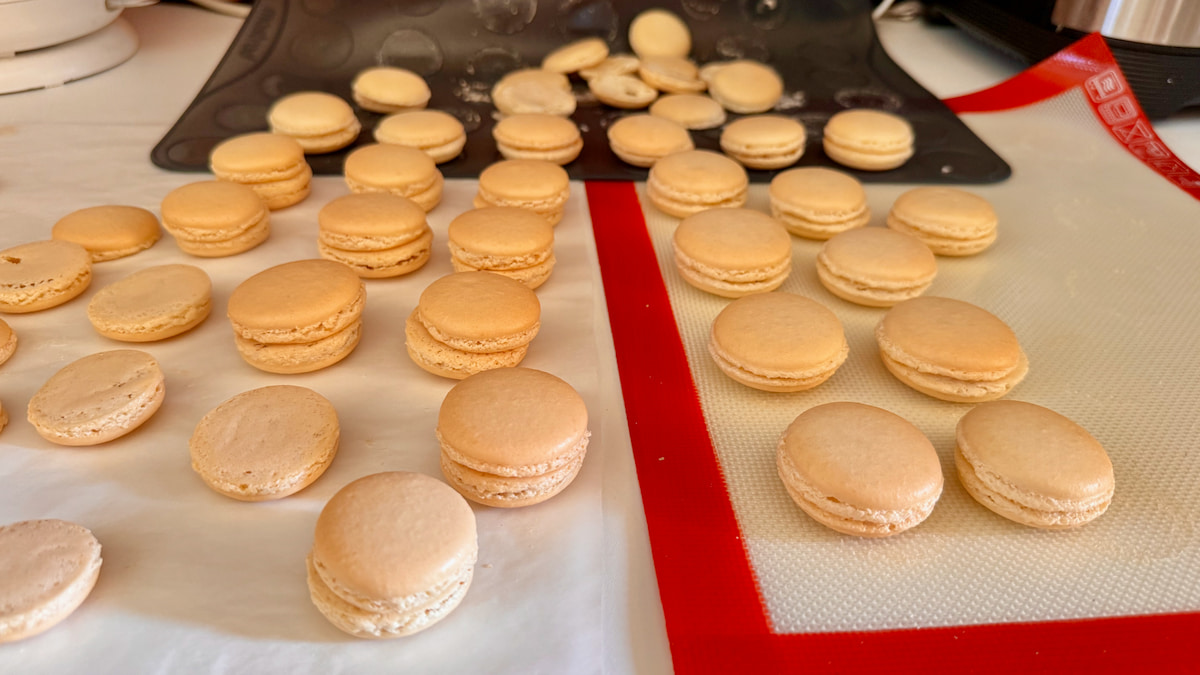
Table of Contents
- How I Tested Macaron Mats vs Parchment
- The Results
- Why Do Silicone Mats Give Smaller Feet?
- Do You Need a Silicone Mat for Macarons?
- Flat Silicone Mats vs Grooved Macaron Mats
- Mat Size and Baking Tray
- Why Are My Macarons Sticking?
- How to Use and Clean a Silicone Macaron Mat
- My Favourite Use for a Grooved Macaron Mat
- My Verdict: Parchment Paper Wins
How I Tested Macaron Mats vs Parchment
To make the test fair, everything was identical except the surface underneath:
- same batch of French-meringue batter, divided between trays
- same piping size (2.5 cm / 1-inch) and the same resting time
- same oven, temperature and shelf, one tray at a time
- same flat baking trays
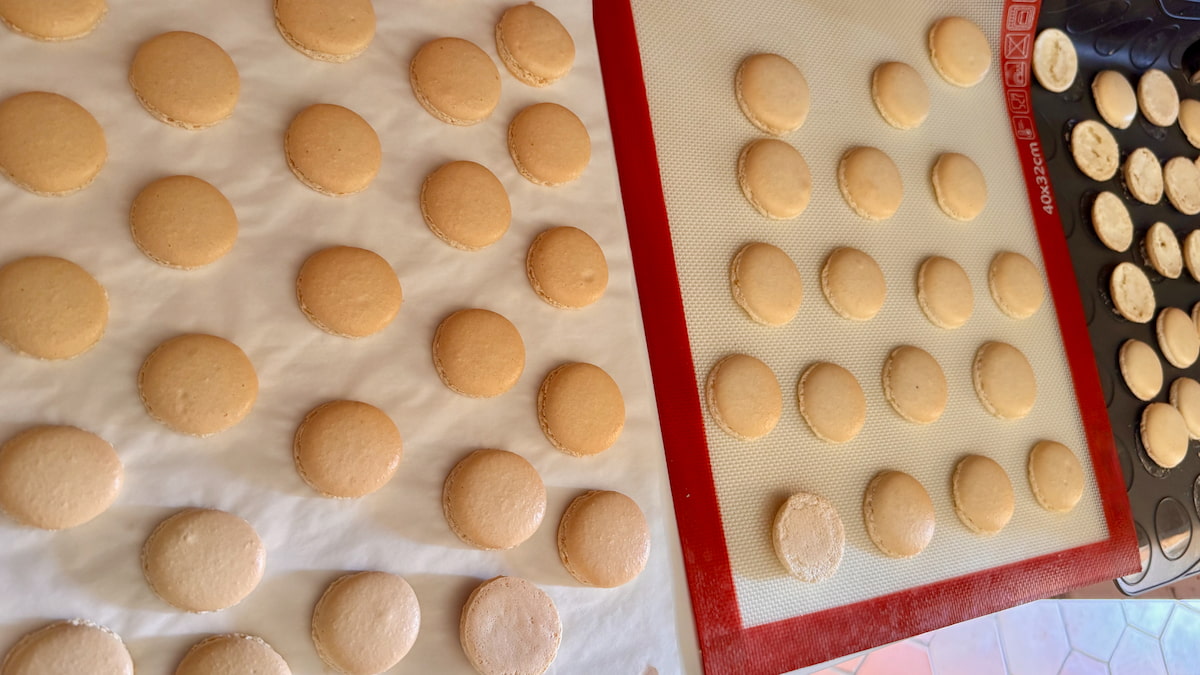
The three surfaces were good-quality baking parchment, a flat silicone baking mat and a grooved silicone macaron mat with raised circles.
The Results
For me, good-quality baking parchment wins.
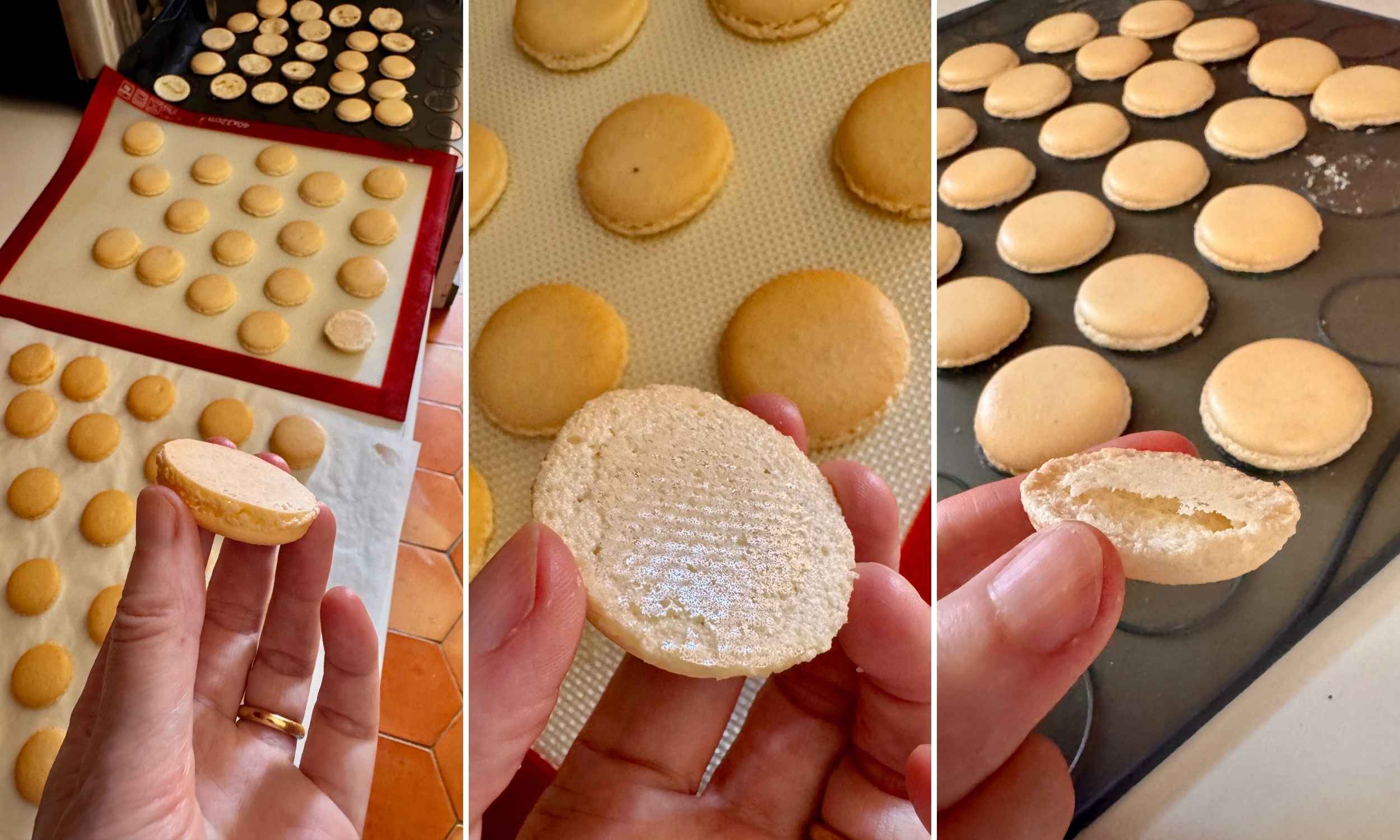
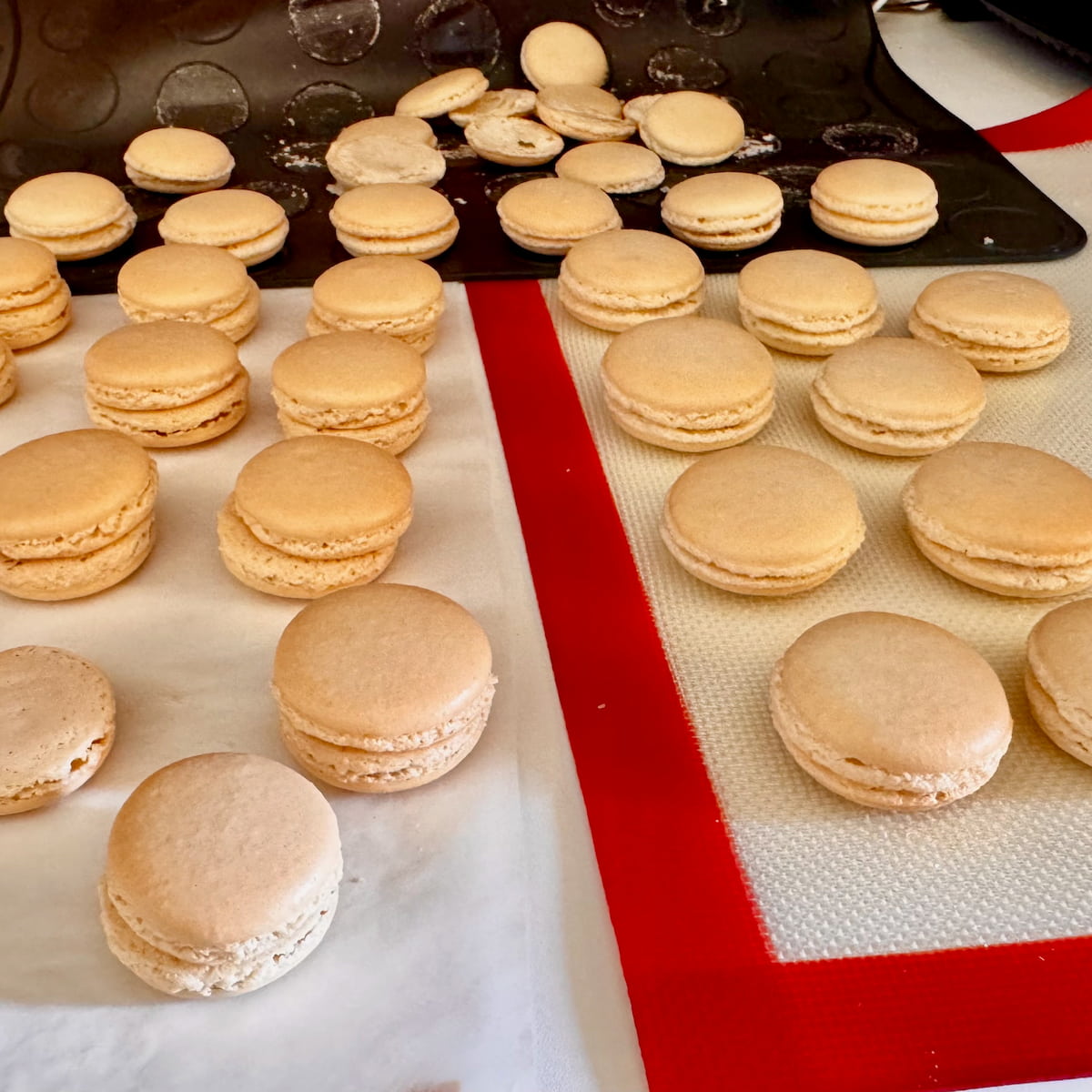
The parchment macarons had taller, more even feet, nicely domed shells and flat, matt bases. Both silicone mats gave smaller feet, flatter shells and shinier, slightly concave bases - and they needed slightly longer in the oven. At times with the mat, I even had no feet. Here's the comparison at a glance:
| Parchment paper | Flat silicone mat | Grooved macaron mat | |
| Feet | Tallest and most even | Smaller | Smallest |
| Shape | Nicely domed | Flatter | Flatter |
| Bases | Flat, matt and dry | Shiny, slightly concave | Shiny and more concave |
| Baking time | My usual time | Needed longer | Needed longer |
| Release | Peeled away cleanly once cool | Can stick if underbaked | Can stick if underbaked |
| My verdict | ? Winner | Workable | Not for me |
The biggest surprise was the grooved macaron mat. It does help you pipe evenly sized rounds, but the raised edges left the undersides shiny and hollowed, rather than flat.
Why Do Silicone Mats Give Smaller Feet?
This is the clearest differences in my tests each time. Parchment gives me higher, more pronounced feet. Both silicone mats produce flatter ones, with the grooved mat giving the smallest.
Silicone is an insulator, so heat reaches the base of the shell more slowly than through thin parchment on a metal tray. That seems to mean the feet don't rise as strongly, and the bases need longer to set.
That's also why mats can be confusing. If you bake for the same time as on parchment, the shells look done but are underbaked underneath. That's when you get sticky, concave bases, and more hollow shells.
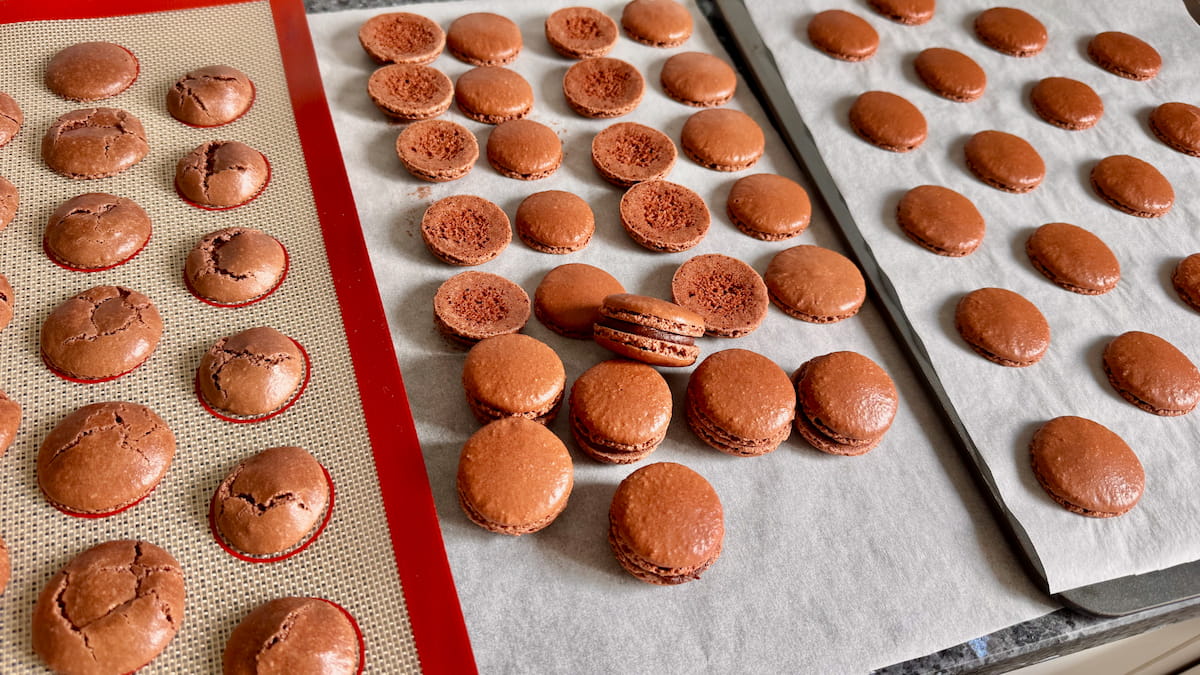
Mats also hold on to a thin film of grease over time, even when they look clean - and grease is never good news for macarons. That leads to no feet and cracks - just check out these chocolate macarons from the same batch with some grease on the mat.
Do You Need a Silicone Mat for Macarons?
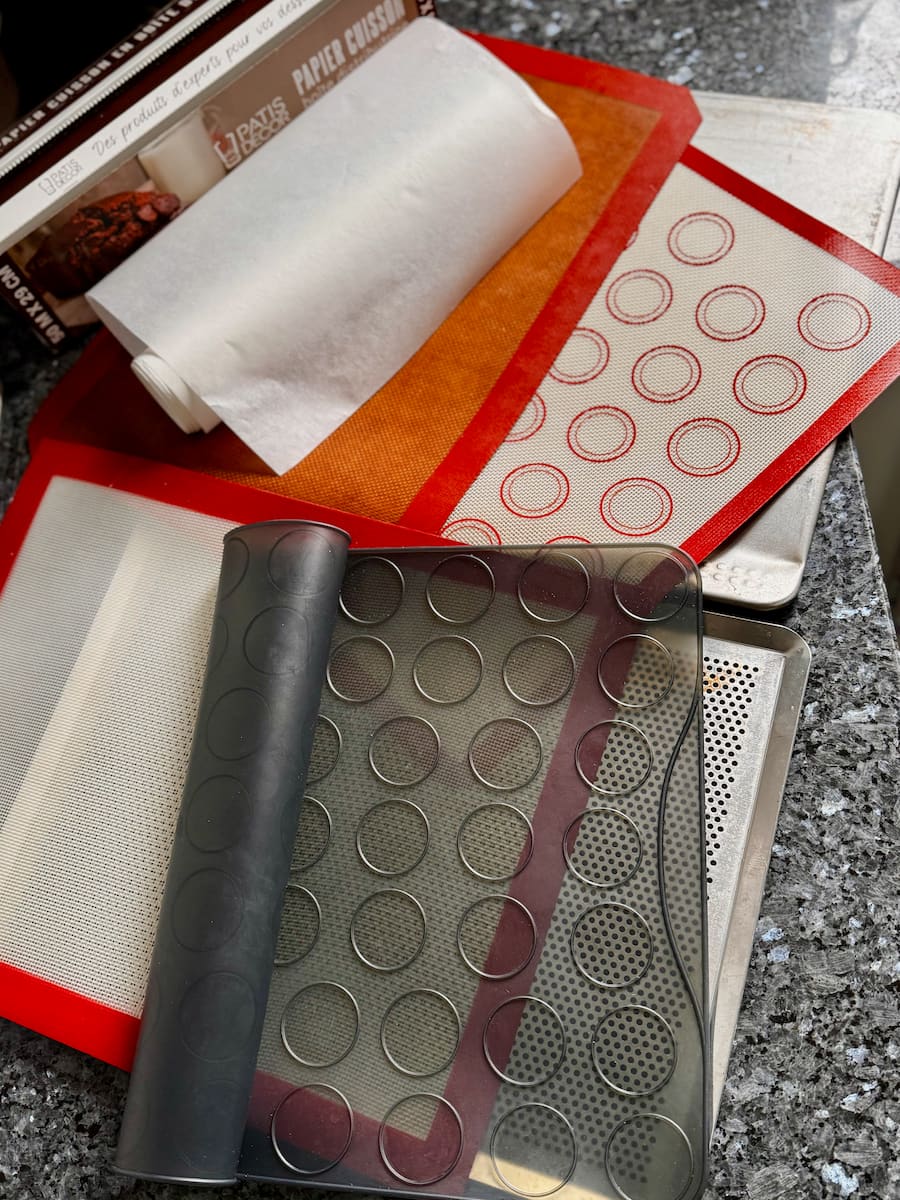
No. A silicone mat isn't essential, and I don't normally use one. Good baking parchment on a flat, heavy baking tray is all you need. It's inexpensive, easy to find, and in my tests it gives better feet and flatter bases.
Can You Make Macarons Without a Silicone Mat?
Absolutely - and I usually do. Use good-quality baking parchment, not wax paper, and hold the corners down with tiny dots of macaron batter if you have a stronger fan oven that lifts it.
For even sizing, slide a printable macaron template under the parchment while piping, then remove it before baking.
A flat baking tray matters too. A warped tray can give you lopsided shells whichever surface you use. If I use silicone, I also like placing it on a perforated metal baking tray.
Flat Silicone Mats vs Grooved Macaron Mats
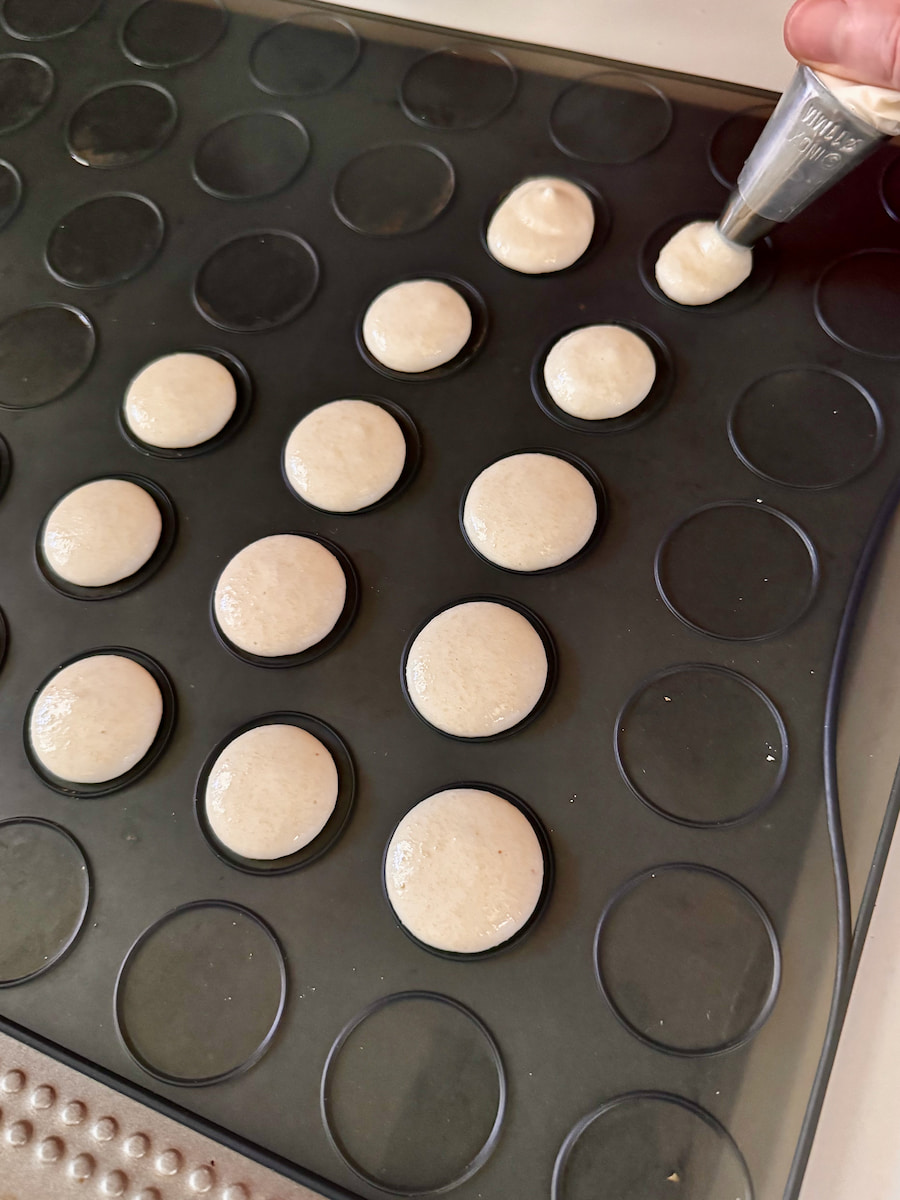
A flat silicone mat, including one with printed circles, simply gives you a visual piping guide. The raised circles sound helpful, but I find them more awkward than parchment.
You need to pipe neatly into the centre and leave enough room for the batter to spread. Pipe slightly off-centre and the shell can turn oval or reach the raised groove.
Rather paradoxically, you need fairly accurate piping to make the guide work well.
What About Double-Circle Macaron Mats?
You'll also see macaron mats with two circles rather than one. In my experience, they don't change very much. The extra circle gives another size guide, but you still need to pipe centrally and allow the batter room to spread.
If the circles are simply printed on a flat silicone mat, fine. If they're raised grooves, I still find parchment easier.
Mat Size and Baking Tray
it's worth checking the size of your mat and baking trays before buying one.
My grooved mat was slightly too large for one of my favourite trays, which meant it wasn't fully supported so some shells spread unevenly. Make sure:
- the entire mat lies flat on the tray.
- the tray fits comfortably in your oven.
- you use a strong, flat tray underneath.
For silicone, I now particularly like a perforated metal baking tray underneath.
Why Are My Macarons Sticking?
Sticking to paper or to silicone usually means:
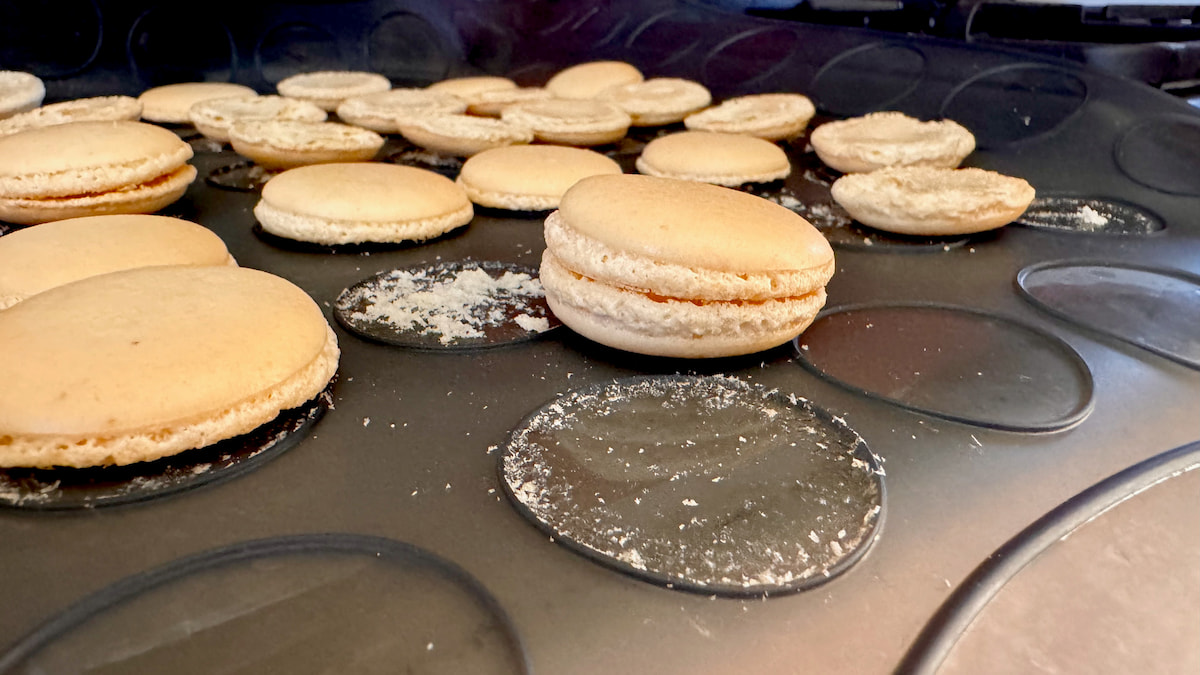
- They're underbaked. This is the most common reason, especially on mats. Bake a couple of minutes longer.
- They haven't cooled. Leave them to cool completely before lifting.
- The mat isn't completely clean. Grease residue makes the bases stick.
How to remove macarons cleanly: let them cool completely, then peel the paper away from the shells, rather than pulling the shells off the paper. If they still cling, they need more baking - pop the next tray in for a minute or two longer.
How to Use and Clean a Silicone Macaron Mat
If you prefer silicone mats, a few tips will help:
- Keep one mat just for macarons, never for roasting or greasy baking.
- Wash it in hot soapy water and rinse well. To remove a greasy film, scrub gently with a paste of bicarbonate of soda and water, then rinse.
- Dishwasher? Many mats are dishwasher safe - check your manufacturer's instructions.
- Never oil it and replace it if it looks stained or smells. Older mats rarely give good macarons.
- Bake a little longer than on parchment - test one shell before taking the tray out.
My Favourite Use for a Grooved Macaron Mat
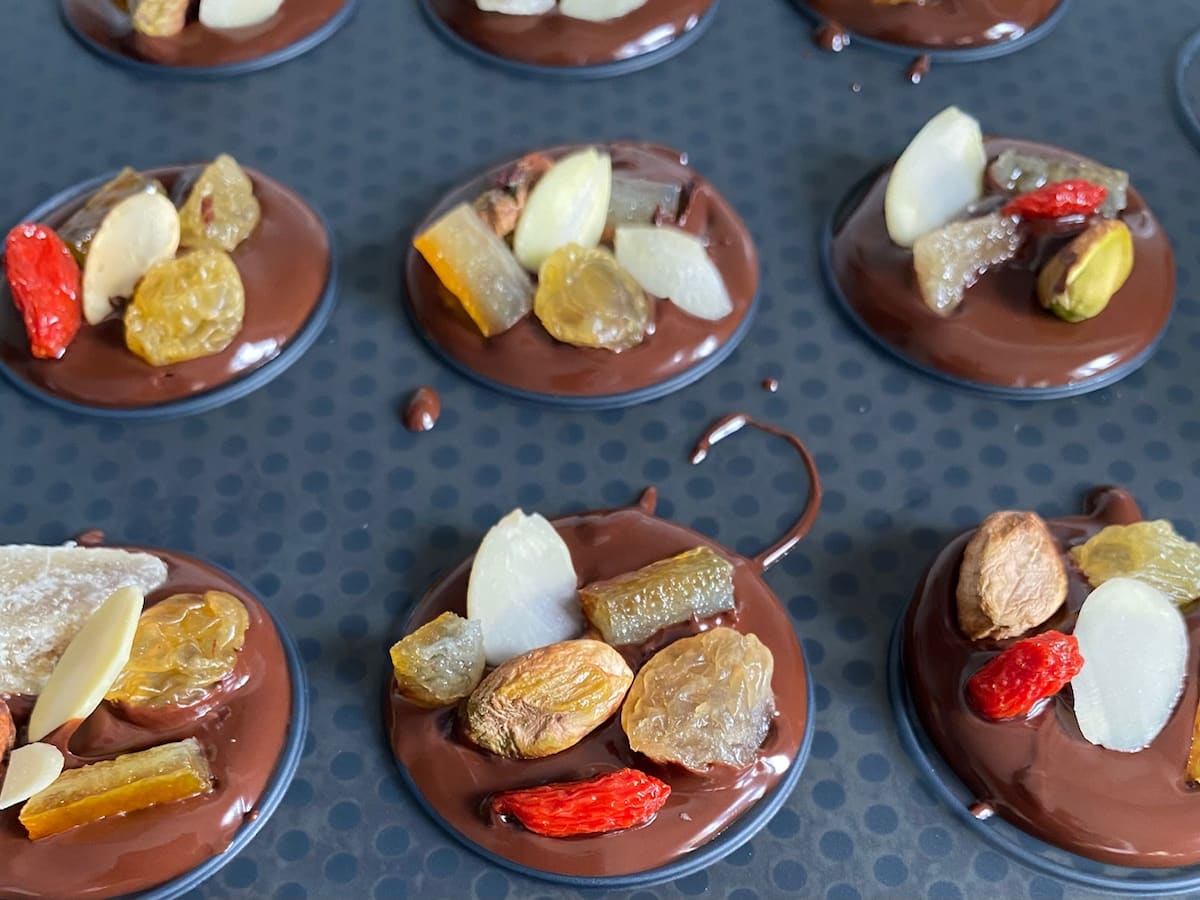
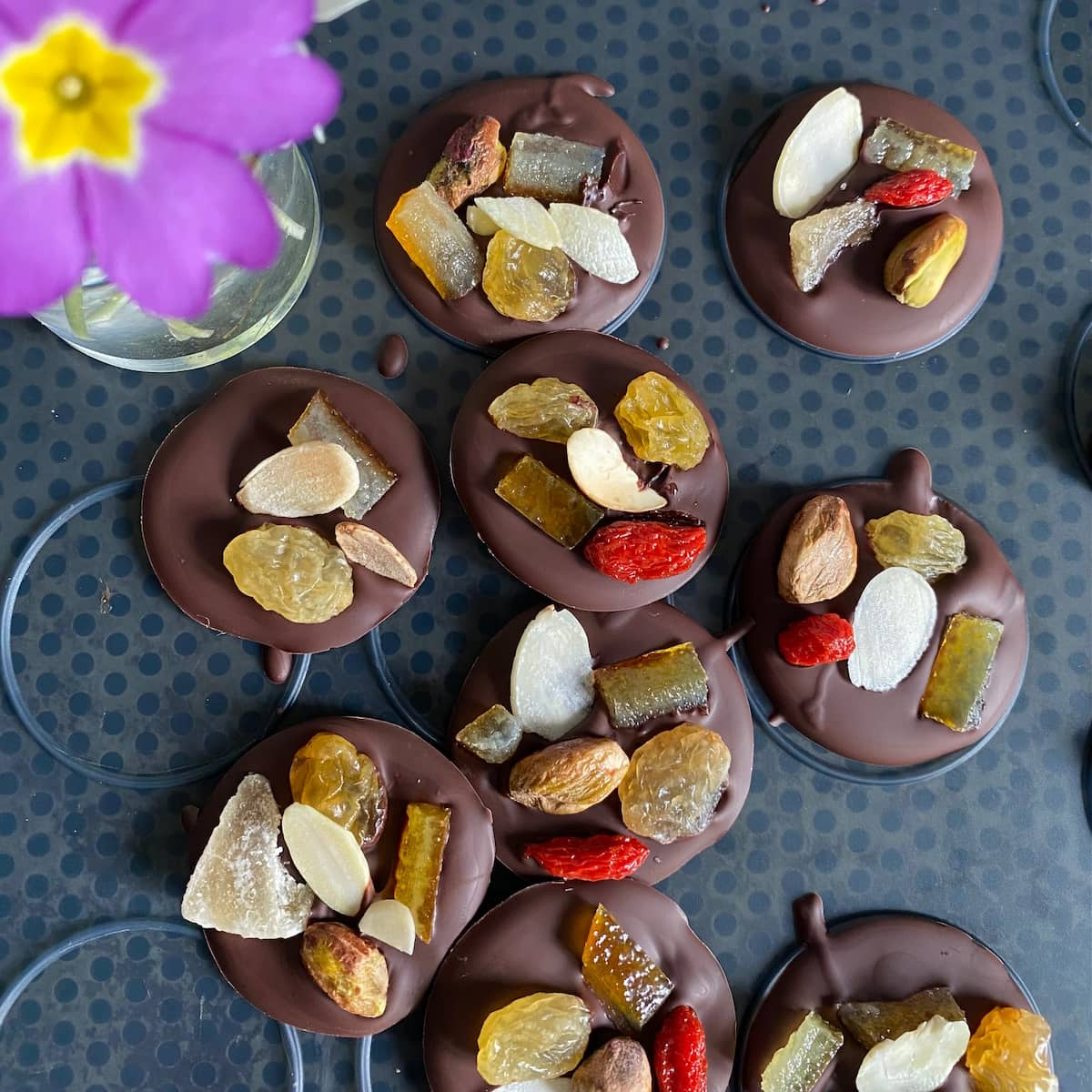
I no longer use my grooved mat for macarons but I definitely haven't thrown it away. Those circles are perfect for making this French Chocolate Mendiants recipe.
Spoon the melted chocolate into the grooves, decorate with dried fruit and nuts, leave to set, then peel the silicone away. You get beautifully round chocolate discs with almost no effort.
No wastage - and very French.
My Verdict: Parchment Paper Wins
For me, parchment paper wins every time: better feet, flatter bases and reliable timing. Silicone mats can work if you bake longer and keep them spotless, but I wouldn't buy a grooved macaron mat for beginners. A free printable template under parchment does the same job, without the concave bases.
That's my opinion after many batches in my own kitchen. If mats give you better results, go ahead! Macarons are all about finding what works in your own oven.
Recommended: baking parchment; sturdy flat baking tray.
Originally published 31 August 2012. Completely retested and updated.
Want More Macaron Help?
For my beginner recipe, troubleshooting fixes, fillings, tips and Paris favourites, see my complete French Macaron Guide


Jenny Bui
Hi Jill ,
Can I reduce the amount of sugar since the original macaron recipe always too sweet for our taste . Will this affect the rising feet from Macarons ? Thank you
Jill Colonna
Yes, you can reduce the sugar slightly but be careful. Yes, it will affect the result - that's why I developed my own macaron recipe in both my books, starting with Mad About Macarons. There's a chapter with even more reduced sugar (as much as I dare!) with savoury macaron recipes too. Have fun!
Michelle Duong
Jill, my macarons always stick so much whenever I use this mat! But whenever I try to bake them longer, they brown and are too hard. I can't freehand because whenever I bang the tray on the table, the shapes become a mess! What can I do?
Jill Colonna
Hi Michelle,
Are you using my recipe? I ask since recipes can change the outcome and it helps me to help! Sounds like your batter is too runny - and I don't encourage readers to bang the tray on the table with this recipe. Let me know more so I can help.
Jay
I really love this product. I have use it in my home country in Cambodia. It is easy to use and perfect for family.
Thanks!
Vera
Hi Jill, thank you for your article, I am about to buy Mastrad Mat just to experiment. I always make macarons using parchment paper and turn out good, though occasionally turned oval. So now I won't experiment with mat after reading your article. I am interested to buy your book, where and how, I am in Australia. Thanks
Jill Colonna
Hi Vera, Sorry for the late response but have been on holiday and away from le blog. You can find both books on the Book Depository. For Australia, I'm not too sure...
David Chau
Hi Jill,
My macarons are round during drying time and before baking, but turned oval shapes when baked. What do you think I did wrong?
Regards,
David
Jill
Hi David,
It sounds like your batter is slightly on the liquid side. For this, there are a number of reasons:
over-beating the batter; not whipping up the whites enough into stiff peaks; not good quality eggs; incorrect measurement of ingredients (you need to follow the recipe to the letter).
Or, as you mention, your baking parchment isn't great quality. I have asked my Canadian baking friends and will be back in touch!
Jill
David Chau
Hi Jill,
What is the brand name of the "high quality" parchment paper that you use for your macarons? I am from Canada and the one I use is called "Culinary Parchment". Before the macarons are baked, they are perfectly rounded. But after baking, most of them take on an oval shapes. Other than that, they are great.
Regards,
David
Jill
My Canadian friend, Mardi Michels, tells me that her favourite quality brand of parchment paper is Paper Chef in Canada
Cheers, Jill.
David Chau
Thank you, Jill, for helping me out.
Jill
Pleasure, David!
Jelena
David, I wonder if your oven’s fan is too strong? This may cause the macaron to change shape while baking. silicon mats can help hold the shape a bit better but parchment doesn’t block the heat. If the recipe calls for leaving macaron until skin forms try and leave it for a few additional minutes to help retain the shape on parchment.
najma
i have just brought macarons decorating set before using i need your advise is it ok to use and pls forward your receipe do i have to put tray underneath the silocone sheet pls reply
thanks
Jill
Hi Najma,
As I say here, I prefer NOT to use a silicone mat for macarons. I'm sorry but my publisher does not allow me to put up the recipe here, as they prefer readers buy the book (and at a small price, it's value for money for the same as a box of macarons in Paris.) To answer your question, though, if you are wishing to use a silicone mat then yes, you would put the baking tray underneath it. All the best, J.
Praveen
Hi Jill, i use silicone mat and bake macaron at 140 C in convection oven for around 25 mins. How do I test if they are done? They don't move easily and stick to the mat. Even after cooling the base of shell is not clean. pls help.
Jill
Hi Praveen, first off 140°C sounds too low an oven temperature to me and for too long - but perhaps you're using a different recipe. Are you following all the instructions from 'Mad About Macarons'? It's all in the book for guidance on this - and, as I say in the post, I don't like using a silicone mat but rather good quality parchment/baking paper. In the book, I bake at 160°C fan although, depending on your oven, this can be lowered to 155° or 150°C (I don't recommend any lower).
Praveen
Thanks for the prompt response Jill. How long to bake at 160 °C ? currently, i get a neat shell and foot as well but the base of the shell is not clean. May be once i adjust the temp to 160 °C would i get clean base?
Jill
It all depends, Praveen. If you're using my recipe, it's easier to say how it will go but if you're doing it from another version, I can't guarantee it will work. My recipe is at 160°C fan for only 8-10 minutes and after they come out with a clean base. All the instructions are given in the basic recipe. Cheers!
Tina
How important is the feet on the macaron shells?
I just baked two batches for the very time but using parchment paper on insulated cookie sheets. No feet. They didn't have smooth tops because maybe the batter was too thick. But tasted very good. Slight crisp with slight soft chewiness in the middle. Still wondering if we I should buy the lekue silicon mat and batter dispenser.
Jill
Hi Tina,
Sorry - been away, still away and only have a quick connection time here. A macaron without feet is, well really, not a macaron. As I say in my book. Are you using my recipe from Mad About Macarons and sticking to the instructions? It's all in the book - including just using a piping bag. All these gadgets are not really necessary...
Emma-Jane
Wish I thought to google 'macaron mat' before I piped them out! They appear to be quite round and even, but I have yet to cook them! I am despairing of how I will get them off once cooked, as my macarons almost always stick!
Emma-Jane
Update! Well, that was a waste of time! There is plenty of rise, but on one side only, and not the same side one each macaron, interestingly. And, they are not cooked, despite adding an additional 2 minutes to the cooking time. Back to the mixmaster!
Jill
Thanks for the feedback, Emma-Jane. Sorry to hear you saw this post a bit late and spent the money on a macaron mat but as I say here, you can use the mat to shape chouquettes and mendiants!